Mistakes
10 Wallpaper Mistakes to Avoid (and How to Hang It Right)
Bubbles, gaps, peeling seams and mismatched patterns — the 10 most common wallpaper mistakes and how to avoid them, plus a quick hanging method for beginners.
- Difficulty
- Beginner–Intermediate
- Time
- 1 day per room
Wallpaper has made a big comeback — and modern papers, especially paste-the-wall non-wovens, are much easier than the old kind. Still, a few classic mistakes can ruin the look. Avoid these ten.
1. Hanging on an unprepared wall
Wallpaper shows every bump and crack. Fill, sand and prime the wall. A wallpaper primer (or "size") helps the paper slide into position and makes future removal much easier.
2. Using the wrong paste
Non-woven papers usually use paste-the-wall; traditional paper needs paste-the-paper and "booking" (folding it pasted-side-to-pasted-side for a few minutes). Heavy vinyls need heavy-duty paste. Read the label symbol on the roll.
3. Mixing batch numbers
Rolls printed in different batches can differ in color. Check the batch (lot) number on every roll and buy one extra. Our wallpaper calculator tells you how many.
4. Trusting corners to be straight
Walls and corners are rarely perfectly vertical. Draw a plumb line with a level for your first strip, and redraw it on each new wall.
5. Starting in the wrong place
Start at the least visible corner or next to a door, so the final strip — where the pattern may not match — ends up hidden. With a bold pattern on a feature wall, start from the center.
6. Ignoring the pattern repeat
Straight-match and drop-match patterns need extra length per strip. Cut each strip with the repeat in mind and number the strips on the back.
7. Overlapping seams
Modern wallpaper is butt-jointed — edges touch without overlapping. Overlaps create ridges and peel. Press seams with a seam roller, but don't squeeze the paste out.
8. Stretching the paper
Pulling a wet paper to "make it fit" causes gaps once it dries and shrinks. Slide it into position instead.
9. Leaving air bubbles
Smooth from the center outwards with a brush or plastic smoother. Small bubbles in traditional paper often disappear as it dries; larger ones can be pierced with a pin and pressed flat.
10. Wiping paste off too late
Clean paste from the surface immediately with a damp sponge — dried paste leaves shiny marks.
Quick method for paste-the-wall wallpaper
- Prime the wall and let it dry.
- Draw a plumb line one roll-width minus 1/2 in (1 cm) from the corner.
- Cut strips to wall height plus 2 in (5 cm) top and bottom.
- Roll paste onto the wall, slightly wider than one strip.
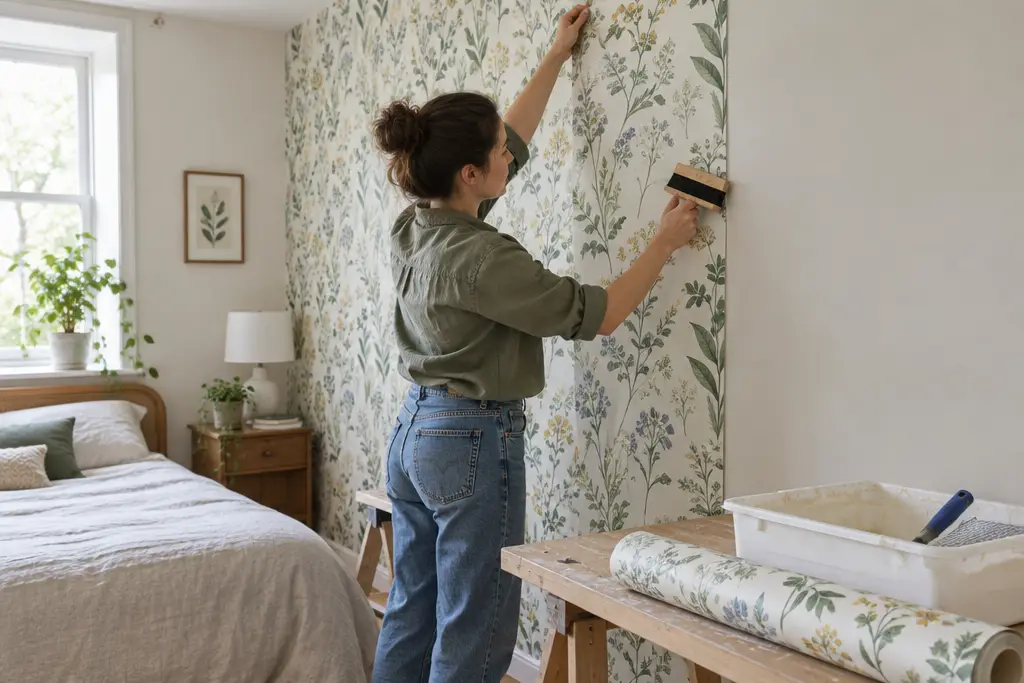
- Hang the dry strip, aligned to the plumb line, overlapping ceiling and baseboard.
- Smooth, then trim excess with a sharp blade against a wide putty knife. Change blades often.
- Repeat, butting each seam to the previous strip.
Keep reading
Wallpaper calculator
Accurate roll count using the strip method, including pattern repeat.
12 painting mistakes and how to fix them
Roller marks, bleeding tape lines and blotchy patches — causes and fixes.

Bedroom & living room makeover
The easiest rooms for a first DIY project: walls, floors, lighting and cozy details.