Materials
Primer vs Spackle vs Joint Compound vs Plaster: What’s the Difference?
Confused by wall prep products? A clear guide to primers, spackle, joint compound (all-purpose, lightweight, setting-type), plaster and wall adhesives — what each is for.
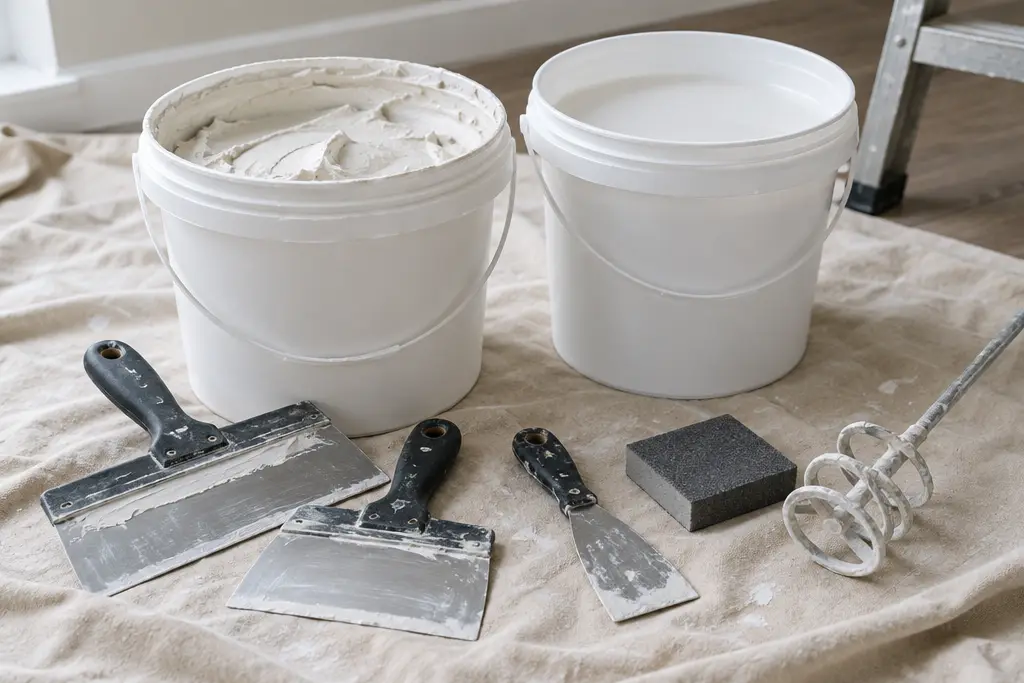
- Difficulty
- Beginner
The paint aisle is full of buckets that look identical. They are not. Using the wrong one is the number-one reason for cracked patches and peeling paint. Here is the cheat sheet, in the order you would normally use them.
Quick comparison
| Product | What it does | Use it for | Layer thickness |
|---|---|---|---|
| Plaster (gypsum or cement-based) | Builds up and levels walls | Uneven masonry walls, big repairs | Thick: 1/4–1 in (5–25 mm) |
| Setting-type compound ("hot mud") | Hardens chemically in 5–90 min | Deep holes, first coat on tape, fast repairs | Medium |
| All-purpose joint compound | Air-dries; strong and sandable | Taping drywall seams, first coats | Thin–medium |
| Lightweight / topping compound | Air-dries; very easy to sand | Final coats and skim coating | Thin |
| Spackle | Small-hole filler, low shrinkage | Nail holes, dents, small cracks | Tiny repairs |
| Primer | Seals and bonds the surface | Before paint, especially on new drywall and patches | One coat |
Plaster
Plaster is the heavy-duty material used to create a flat surface over brick, block or badly damaged walls. Gypsum plaster is for dry interior rooms; it's smooth and quick to work. Cement-based render is for damp areas, basements and exteriors. Both are sold as dry powder and mixed with water. Use our plaster calculator to estimate bags.
Joint compound ("mud")
Joint compound is what drywall installers use to hide seams and screws. It comes in two families:
- Pre-mixed (drying type) — ready in a bucket, dries as water evaporates (usually overnight). All-purpose is stronger; lightweight/topping is easier to sand.
- Setting type (powder) — labeled by working time (e.g. 20, 45, 90 minutes). It hardens chemically, shrinks less and is harder. Great for deep fills; harder to sand, so use it for base coats.
Spackle
Spackle is a ready-made filler for small damage. It shrinks less than compound, so one pass often does it. Lightweight spackle is great for nail holes; vinyl or "patching" spackle is better for dents up to about the size of a coin. For bigger holes, use a patch and compound — see how to patch drywall.
Primer
Primer isn't just "cheap white paint". It seals porous surfaces so the top coat dries evenly and bonds properly.
- Drywall primer (PVA) — seals new drywall and compound. Essential, or the paint will look blotchy.
- Stain-blocking primer — covers water stains, smoke, marker and knots in wood. Shellac or oil-based versions are strongest.
- Bonding primer — helps paint stick to glossy surfaces like laminate cabinets or tile.
- Masonry primer / deep-penetrating primer — used on plaster, concrete and screeds before tiling, leveling or painting.
The order of use
- Plaster to level (if needed) — let it dry fully.
- Fill cracks and holes: setting compound for deep ones, spackle for small ones.
- Tape joints and cracks, then 2–3 coats of joint compound, each wider and thinner.
- Skim coat with lightweight compound for a perfect finish.
- Sand lightly, remove dust.
- Prime.
- Paint two coats.
Frequently asked questions
Can I paint directly over spackle?
You can, but patches often "flash" — look duller or shinier than the wall. Spot-prime patches first for an invisible finish.
Is joint compound the same as drywall mud?
Yes. "Mud" is simply the trade nickname for joint compound.
What is the difference between plaster and skim coat?
Plaster is applied in thicker layers to build up or level a wall. A skim coat is a very thin final layer of compound or finishing plaster used to make a surface perfectly smooth.
Keep reading
How to plan a renovation (and the right order of work)
Set the budget, then follow the order pros use: demolition, rough work, walls, ceiling, floors, finishes.
DIY or hire a pro? A job-by-job guide
A traffic-light table of common jobs — green for DIY, amber for "practice first", red for licensed pros.
The beginner tool kit: 15 tools you actually need
The 15 tools that handle most home jobs, what to look for when buying, and what can wait.